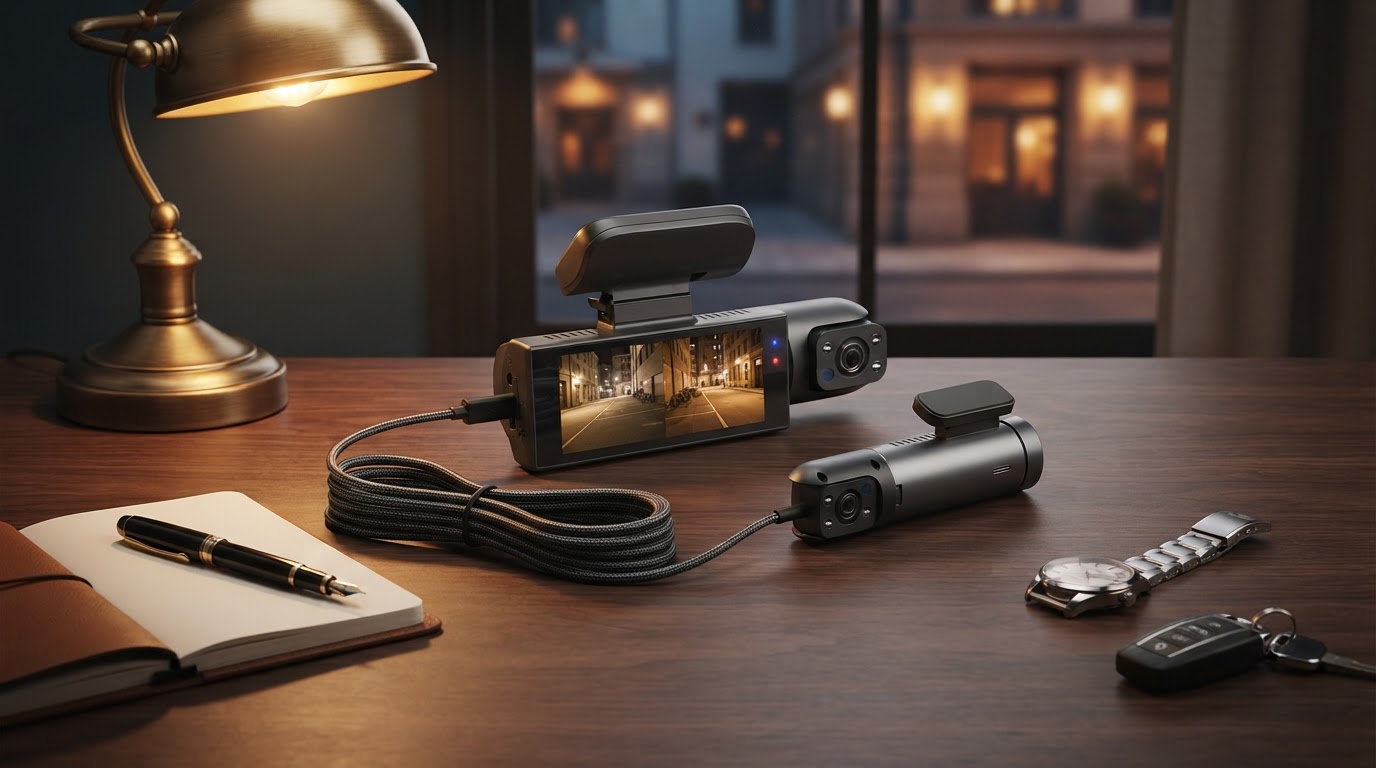
Dual Camera Dash Cam Use for 24/7 Parking Security
 Maya ChenContributing Editor
August 20, 2026. This technical overview examines the functional requirements of parking mode within a dual-channel recording system. It is designed for vehicle owners who prioritize surveillance continuity over simple ignition-based recording.
The Failure of Standard Surveillance Assumptions
The conventional wisdom says that any camera with a battery or capacitor can effectively guard a vehicle while the driver is away. This is demonstrably false. According to The Dash Cam Store, a dashcam with Parking Mode must be able to continue operating when the vehicle is parked and the engine is turned off, which introduces a complex power management problem that most entry-level hardware cannot solve. The primary issue is the energy draw of maintaining a dual-channel buffer. When a system monitors both the front and rear of a vehicle, it is processing twice the data, which typically leads to thermal throttling or premature battery drainage if the system relies on simple voltage detection. Most drivers assume their camera is recording, only to find the unit powered down three hours into a twelve-hour parking stint because the low-voltage cutoff was set too high to preserve the car's ability to start.
Here’s the part nobody talks about: motion detection is a flawed trigger for parking security. In a busy urban environment, a dual dash cam with night vision utilizing basic pixel-change detection will trigger constantly due to passing shadows or swaying trees. This results in hundreds of useless clips that overwrite actual impact data. According to DDPAI, advanced parking mode capabilities now require a combination of intelligent motion detection and smart power management to ensure the system remains active without killing the vehicle's lead-acid battery. Without a dedicated hardwire kit or an external battery pack, a dual-channel system is effectively a paperweight the moment the key leaves the ignition. Relying on internal batteries is a recipe for failure, as lithium-ion cells degrade rapidly under the high-heat conditions of a parked car in summer.
Dual Camera Dash Cam Integration and Power Logic
Photo by Erik Mclean on Pexels
A Dual Camera Dash Cam solves the blind-spot problem by providing a 360-degree context that single-lens units lack. When an impact occurs at the rear bumper, a front-facing camera might catch the vibration but will miss the license plate of the departing vehicle. The integration of a secondary lens allows for a synchronized timeline where metadata from both sensors is timestamped and locked into a protected folder. For those implementing a 4k dual dash cam setup, the data requirements increase significantly. High-resolution sensors pull more current, meaning the parking mode must be more efficient. The industry is shifting toward low-bitrate recording rather than motion triggers; instead of waiting for an event, the camera records continuously at a lower frame rate, ensuring that the seconds leading up to an incident are never lost to a slow sensor wake-up time.
Run the math: A standard dual-channel system draws approximately 300-500mA. On a standard 50Ah car battery, you hit a 12.2V cutoff in less than 24 hours. This is why high-end units like those discussed by Vortex Radar utilize radar-based protection. The Thinkware U3000 Pro, for instance, uses radar to detect approaching objects and only then initializes the recording buffer, significantly reducing power consumption compared to traditional optical motion sensing. For users who cannot hardwire their systems, the wireless dual dash cam for cars category offers some flexibility, but these still require a consistent 12V source to maintain a 4k dual dash cam stream. Furthermore, a [dash cam with interior camera](/blog/dual-dash-cam-with-night-vision) is often preferred by rideshare drivers to document liability, but for parking mode, the rear-facing external lens remains the superior choice for hit-and-run evidence.
Evaluating Parking Mode Hardware Requirements
When selecting a system for stationary surveillance, the decision should be based on power efficiency and trigger reliability rather than just resolution. A front and rear dash cam with night vision is useless if the power management system shuts down the rear sensor to save energy. According to Get Nexar, the most effective parking protection for modern drivers often involves LTE connectivity, such as the Nexar One, which sends real-time alerts to a smartphone when an impact is detected. This moves the system from passive recording to active notification, though it requires a constant data connection.
To ensure your parking mode is actually functional, follow this hardware checklist:
- Verify the presence of a supercapacitor rather than a lithium-ion battery to ensure thermal stability during long parking durations.
- Confirm the system supports a 3-wire hardwire kit (Battery, Accessory, and Ground) to enable automatic switching between driving and parking modes.
- Select a unit that offers low-bitrate recording options to avoid the "missed trigger" pitfalls of motion detection.
- Check for adjustable low-voltage cutoff settings to prevent the dash cam from draining the vehicle battery below starting capacity.
- Prioritize systems with buffered parking mode, which saves the 10-15 seconds of video prior to an impact trigger.
- Ensure the front and rear dash cam firmware allows for independent sensitivity settings for the G-sensor in parking mode versus driving mode.
Shop Dual Camera Dash Cam here
Sources

Photo by Valeriia Miller on Pexels
- Buy Dashcams with Parking Mode | Protect Your Vehicle ...
- What's the Best Dash Cam in 2026? My Picks After Testing
- Best Dash Cams with Parking Mode: 24/7 Car Security ...