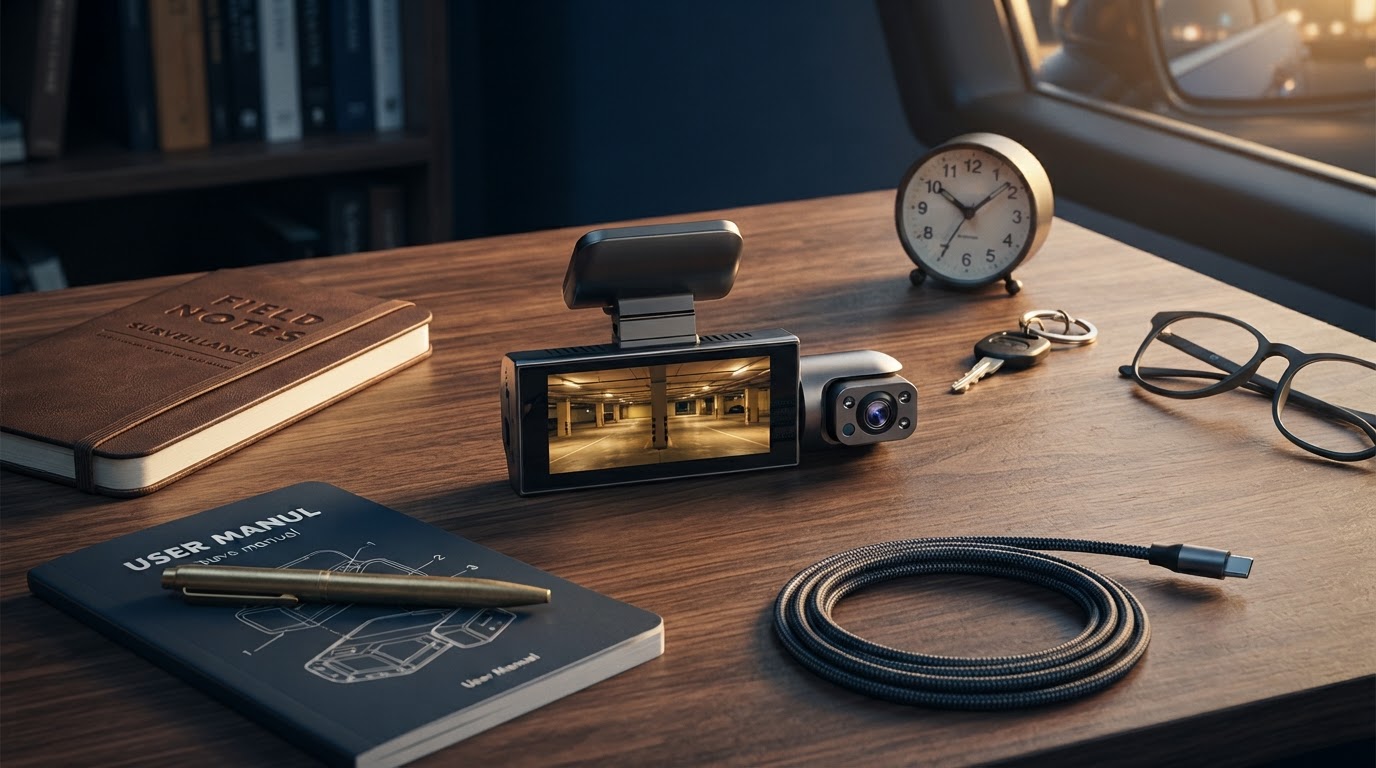
Dual Camera Dash Cam Selection for Parking Mode Security
 Priya RamanSenior Analyst
October 22, 2026. This analysis evaluates the technical requirements for deploying a dual camera dash cam system capable of continuous vehicle monitoring. It provides a structured decision framework for vehicle owners prioritizing stationary surveillance and incident documentation.
The Stationary Surveillance Challenge
Maintaining situational awareness while a vehicle is unattended presents a unique set of technical hurdles compared to standard driving recording. The primary conflict exists between the desire for high-resolution, multi-angle coverage and the finite energy reserves of a vehicle battery. Standard recording consumes significant power; therefore, a sophisticated parking mode must balance vigilance with efficiency. According to BlackboxMyCar, maximum parking mode protection is achieved through features like Auto-Event Detection with buffered recording, which captures the moments immediately preceding a physical impact. Think of it as a matrix of energy consumption versus data granularity. Without a dual-channel setup, a vehicle remains vulnerable to rear-end impacts or side-swipes that occur outside the front lens's field of view. This is particularly relevant for specialized vehicles, such as those discussed in our analysis of the wireless dual dash cam for rv, where the distance between the front and rear of the vehicle complicates traditional wiring but increases the need for comprehensive perimeter monitoring. For the general consumer, the goal is to mitigate the risk of hit-and-runs where the offending party is not captured on a single-lens system.
Technical Implementation of Dual Systems
When evaluating a Dual Camera Dash Cam for parking security, two axes matter here: the detection method and the recording format. Modern systems typically employ one of three strategies: Motion Detection, Time Lapse, or Low Bitrate recording. Motion detection relies on the image sensor to identify pixel changes, while G-sensors detect physical vibrations. Advanced models, such as the VIOFO A229 Pro, utilize buffered recording to ensure that the five to ten seconds before a sensor is triggered are saved to the memory card. This is essential for identifying license plates of moving vehicles that might strike a parked car and flee. For those managing larger fleets or commercial assets, the requirements often shift toward durability and long-term storage, a topic explored in our review of the dual channel dash cam for truck owners. Furthermore, the integration of 4K resolution on the front channel combined with a high-definition rear channel allows for the legibility of small details under low-light conditions. Because parking incidents often occur at night, the infrared capabilities or high-dynamic-range (HDR) sensors found in a quality dual dash cam with night vision are non-negotiable. Once you see it this way, the distinction between a simple camera and a security system becomes clear: the former documents the drive, while the latter protects the asset.
Decision Framework for Parking Protection
The decision rule: prioritize buffered event detection and low-voltage cutoff protection to ensure the camera never depletes the vehicle's starting battery. While some users opt for external battery packs to extend recording time, a hardwire kit with an integrated voltage regulator is the standard baseline for most installations. This setup allows the camera to draw power directly from the fuse box while monitoring the battery's health. For those who require real-time alerts, connected systems such as a Nexar One on an LTE plan can provide live notifications to a smartphone, as noted by Nexar. This connectivity adds a layer of active defense that passive recording lacks. When selecting your hardware, use the following checklist to ensure the system meets the demands of 24/7 monitoring:
- Voltage Cutoff Logic: Does the hardwire kit allow for adjustable voltage thresholds (e.g., 11.8V or 12.4V) to prevent battery drain?
- Buffered Recording: Does the system capture the 10 seconds prior to an impact, or only the aftermath?
- Storage Capacity: Is the system compatible with high-endurance microSD cards of at least 256GB to handle dual-stream 4K data?
- Thermal Resilience: Is the unit capacitor-based rather than battery-based to withstand high cabin temperatures during summer parking?
- Field of View: Does the combined angle of the front and rear lenses cover at least 280 degrees of the vehicle's perimeter?
Shop Dual Camera Dash Cam here