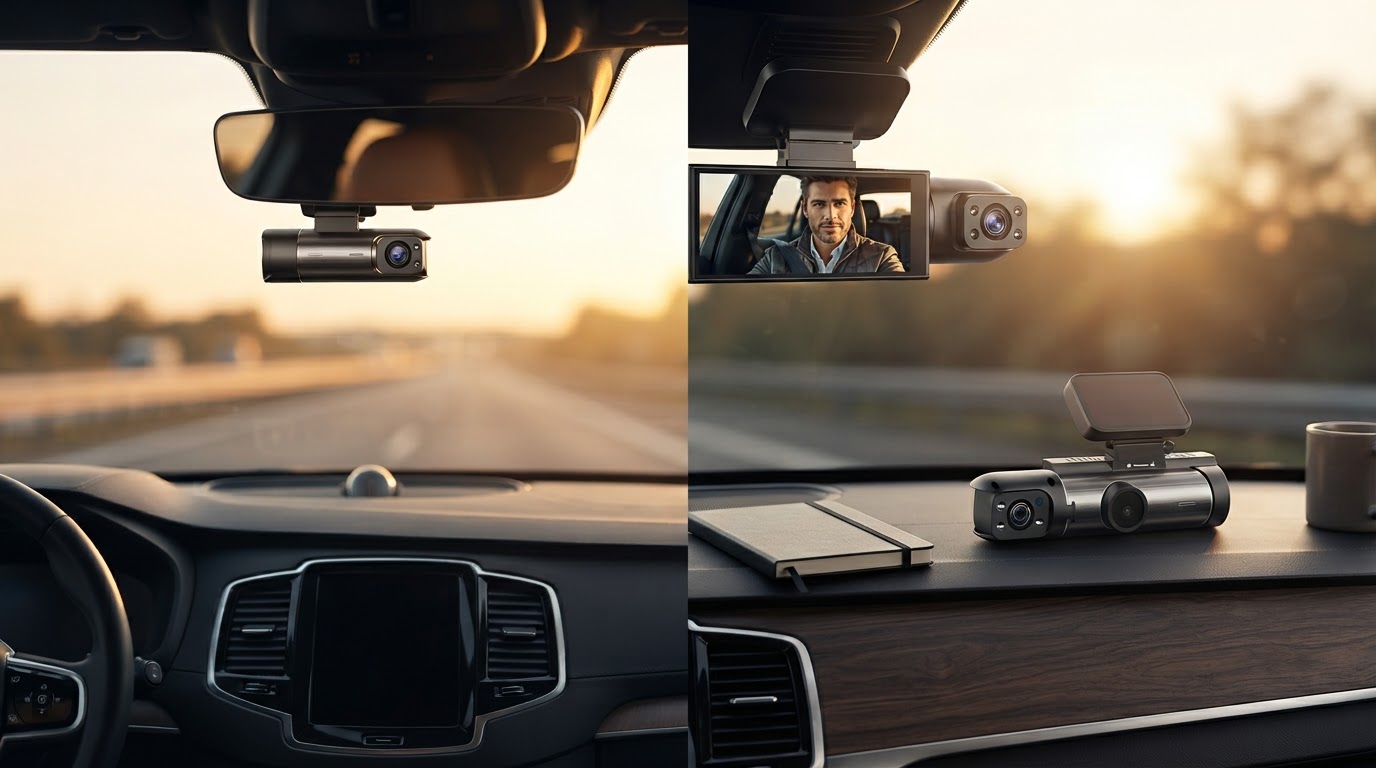
Dual Camera Dash Cam Utility for Cabin Monitoring
 Priya RamanSenior Analyst
September 11, 2026. This analysis evaluates the technical specifications and practical applications of a Dual Camera Dash Cam equipped with an interior-facing lens. It is designed for professional drivers and safety-conscious commuters who require a simultaneous record of the road and the vehicle cabin. Two axes matter here: the field of view required to capture side-window interactions and the sensor sensitivity necessary for low-light cabin recording.
The Liability Gap in Standard Recording
Standard forward-facing cameras leave a significant evidentiary gap regarding the events occurring inside the vehicle. According to Car and Driver, interior cameras are particularly worth considering for those who want to document that they were not distracted during an incident or for parents who wish to monitor children in the backseat. Without a Dual Camera Dash Cam, a driver has no objective record to refute claims of mobile phone use or to document aggressive behavior from passengers. This is especially critical in the gig economy, where driver ratings and platform access depend on verified conduct. Think of it as a matrix of external road events versus internal behavioral data; a single-channel system only provides half the necessary context. When an incident occurs at the driver-side window, such as a traffic stop or a confrontation, a standard dash cam typically misses the interaction entirely. By integrating an interior lens, the system creates a 360-degree awareness zone that protects the driver's professional reputation. For those specifically in the transport sector, understanding why do Uber drivers need a Dual Camera Dash Cam? is the first step in closing this liability gap.
Technical Implementation of Interior Optics
A Dual Camera Dash Cam addresses these vulnerabilities by utilizing dedicated sensors optimized for the unique lighting conditions of a car interior. While the front-facing camera focuses on high-resolution plate capture and dynamic range for sunlight, the interior camera must prioritize infrared (IR) capabilities. VIOFO, for instance, offers 3-channel systems that pair a 4K front camera with an infrared interior camera to ensure visibility even in total darkness. The hardware must balance resolution with storage efficiency; while the front may record in 4K, the interior often utilizes 1080p or 2K to manage file sizes. The Dual Camera Dash Cam performance in cabin monitoring relies on wide-angle lenses, often reaching 140 to 160 degrees, to capture both the driver and the passenger windows. Vortex Radar notes that the Viofo A229 Plus provides this three-way coverage, recording activity from the front, rear, and interior simultaneously. Once you see it this way, the dash cam stops being a simple recorder and becomes a comprehensive witness. This setup is a cornerstone of Dual Camera Dash Cam strategies for rideshare safety, providing the high-bitrate evidence needed for insurance claims. Furthermore, modern systems like the Vueroid S1 4K Infinite utilize Sony Starvis 2 sensors to reduce ghosting in low-light cabin environments, ensuring that facial features remain identifiable even under streetlights.
Decision Framework for Interior Integration
Selecting the right system requires balancing hardware footprint against recording depth. The decision rule: if you carry passengers for hire, infrared interior lighting is non-negotiable; if you are a private commuter, a wide-angle lens for side-impact visibility takes priority. High-end models now feature multiplexing, which combines all camera views into a single video file for easier review, a feature found in the Viofo A329S. When evaluating a dash cam that records inside and outside, the physical mounting of the interior lens is also a factor. Some modules, like those from Nextbase, attach directly to the side of the main unit, while others are tethered by cables to allow for discrete placement. This flexibility is vital for the best dash cam for Uber drivers who need to minimize obstructions on their windshield. Before finalizing a configuration, use the following checklist to ensure the system meets professional standards:
- Verify the interior lens features Infrared (IR) LEDs for night-time cabin visibility.
- Confirm the field of view is at least 140 degrees to cover side-window interactions.
- Check for buffered parking mode to record interior activity during attempted break-ins.
- Ensure the system supports high-capacity microSD cards (up to 512GB) to handle multi-channel data.
- Assess if the interior unit is adjustable to account for different windshield rakes.
- Look for built-in Wi-Fi (5GHz or Wi-Fi 6) for rapid transfer of large multi-camera video files.
Sources
- Best Dash Cams for 2026, Tested and Reviewed - Car and Driver
- Front & Rear & Cabin Dashcam - viofo
- Cabin View Camera | Inside Car Camera - Nextbase